Logistics software development for forwarders who still quote from a spreadsheet
We build and run custom logistics software for freight forwarders and transport companies: quote calculators that work from your own rate sheet, structured quote requests, carrier orders, status pages for customers, and links between your website, TMS and accounting. For an EU road-freight forwarder we built the quoting side: an instant estimate calculator, a validated tariff sheet and structured quote requests. It is built and launching. Carrier orders, status pages and TMS links are not part of that case; they are what we would build for you.
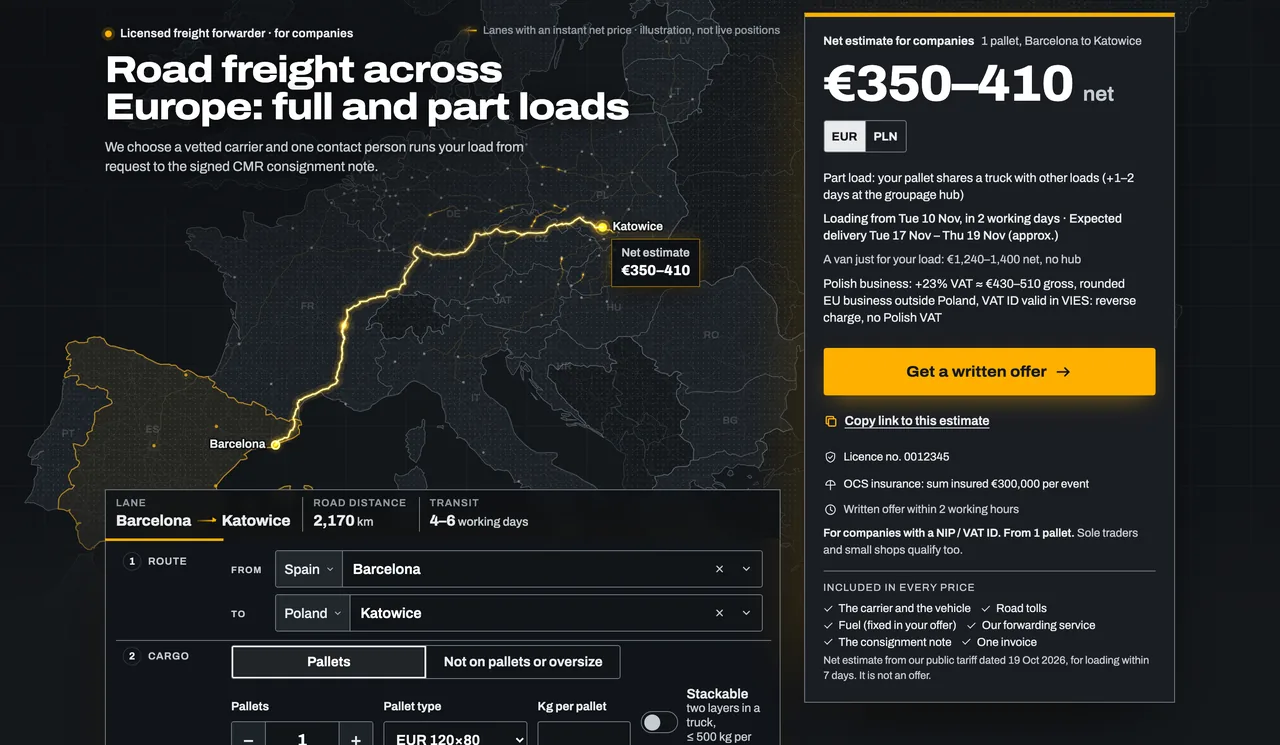
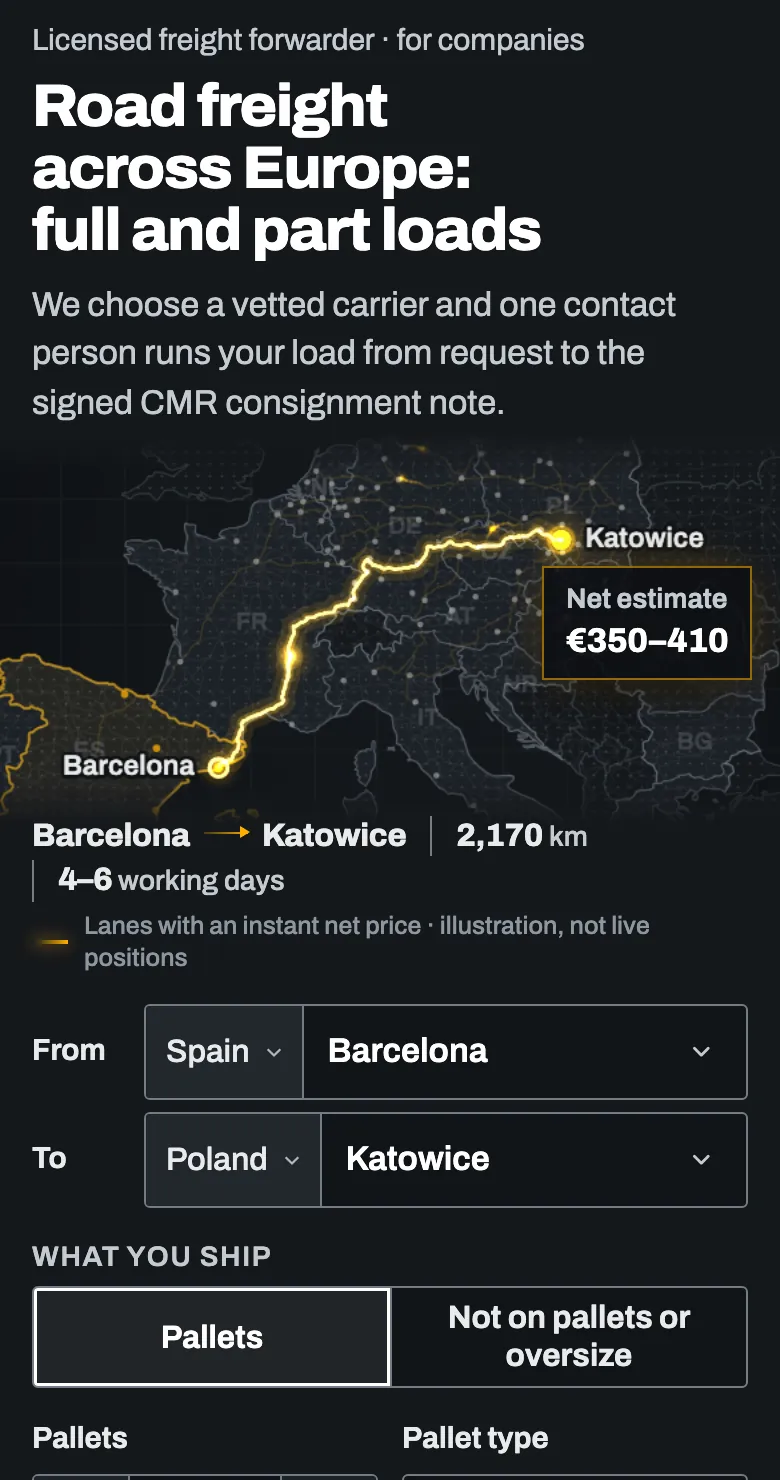
- 13.6 mtrailer deck drawn to scale in the instant estimate
- Routesa page for each corridor and country, each checked for uniqueness
- 3languages on one platform
- 13free tools that bring shippers in
What goes wrong in a forwarding office, and what we build for it
Orders are re-typed from emails and PDFs
Loads arrive as emails, PDFs and spreadsheets, and a dispatcher types each one into the TMS. A typo becomes a wrong pick-up address.
We would buildAn order form with the fields your dispatchers need (pallets, loading metres, dates, addresses), so the load arrives complete and goes into the TMS without re-typing.
The price depends on who has the rate sheet open
A shipper calls for a quote, and the answer changes with the person and the version of the spreadsheet they have.
In the freight caseAn instant estimate calculator that reads your tariff from a sheet you control, with checks that stop a broken rate before a customer sees it.
“Where is my load?” calls eat the day
Customers can’t see status themselves, so they phone, and a dispatcher stops planning to look it up.
We would buildA status page per shipment, fed from your TMS or updated by dispatch, with a link the customer can open instead of calling.
Carriers get orders by email and WhatsApp
Each subcontractor gets the order in a different channel. Confirmations, prices and changes never come back into one place.
We would buildCarrier orders sent from one record, with a link where the carrier confirms, so the reply lands next to the load it belongs to.
POD and CMR photos sit in drivers’ phones
Invoicing waits for paperwork that someone has to chase, scan and file.
We would buildAn upload link per load for proof of delivery and CMR photos. The files attach to the shipment and the office sees the load is ready to invoice.
The website can’t take a quote request
A request by email misses half the details, so the first reply is a list of questions.
In the freight caseA request form that asks for what pricing needs and arrives in the office as a spreadsheet. The one we built produces xlsx and csv files.
TMS, accounting and website don’t talk
Month-end means three exports and an afternoon of matching them by hand.
We would buildConnections between them, through their APIs or scheduled exports, so the same shipment carries the same numbers everywhere. See Integrations.
How the pieces connect
Relevant case
What we built in the freight case
An asset-light forwarder that sells part loads and full loads (LTL, PTL and FTL) without its own trucks needed a site that answers the price question first. We built the platform. It is built and launching.
- An instant estimate calculator that shows the load on a to-scale 13.6 m trailer deck.
- A tariff in a Google Sheet, validated before the calculator uses it.
- Quote requests generated as xlsx and csv files and emailed to the office.
- 28 corridor and 27 country pages in three languages, 13 logistics tools and a place search over about 280,000 places.
What we build for you
None of this is in the freight case. It is the next layer for a forwarder that already has quoting in hand, built around the TMS and accounting system you run.
- Carrier orders sent from one record, with a link where the carrier confirms.
- A status page per shipment, fed from your TMS or updated by dispatch.
- An upload link per load for proof of delivery and CMR photos.
- Connections between your TMS, accounting and website, so a shipment carries the same numbers everywhere.
Quoting freight by email and phone?
Tell us how a quote reaches your office today.
How the work runs
Tell us what happens today
Tell us how quotes, orders and carrier confirmations move through your office now. We reply within one business day, usually within a few hours.
A free first look
An online call, and an outside check of your site with XRay, our own audit tool. A deeper audit is scoped after the call.
Build, or take over
We build the missing parts, or take over a system someone else built. One team covers analysis, build, testing and DevOps.
Keep it running
Fixes, security updates and new features. Hourly billing, one rate for the whole team, a report every week.
You own the code, the data and every account. More on how we work and the systems we have built.
What this doesn’t do
No “replace your TMS” project by default. If your TMS does its job, we connect to it instead of rebuilding it.
No trackers or vehicle hardware. We use the data your telematics or TMS already exposes. We don’t fit or sell devices.
No prices before we talk. Billing is hourly with weekly reports; we scope the work after the call.
No promises about Google rankings. Route pages are built to be useful and indexable. Positions are not ours to promise.
Questions we get from forwarders
Can you work with the TMS we already use?
Usually, yes, if it has an API or can export files on a schedule. We check that on the first call. If it has neither, we look at what can be read from it safely before suggesting anything bigger.
Our shippers send orders by EDI.
We have no EDI case to show. If your EDI messages arrive as files, or pass through a provider with an API, we read them the same way we read scheduled exports, and we check the format on the first call.
Each customer needs their own login, and our staff sign in with company accounts.
Each customer sees only their own records, enforced in the database, not just on the screen. Sign-in through your company identity provider is agreed in the scope, and we check what it supports on the first call.
Do our rates have to live in Google Sheets?
No. A sheet is a good start because your team already knows how to edit it, and the forwarder platform we built uses one with validation. Rates can move into a database later without changing what customers see.
Can the system work in several languages?
Yes. The forwarder platform runs in three languages, with route and country pages in each language. Each page has to pass a uniqueness check before it is published.
Who owns the system once it is built?
You do. You own the code, the data and every account. If you ever move to another team, everything is already in your name.
Where to go from here
Still re-typing loads from email?
Describe where loads and quotes come from today. A few lines are enough to start.
We reply within one business day, Tallinn time (EET), usually within a few hours. No obligation.